Google has made a variety of significant updates to its Search Quality Rater Guidelines.
The most significant overhauls were to Google’s definitions of YMYL (Your Money, Your Life), and the extent to which E-A-T matters as a matter of page quality.
Google provided new, clear definitions for what it means for content to be YMYL, mostly framed around the extent to which the content can cause harm to individuals or society. Google also provided a new table establishing clear examples of what it means for content to be YMYL or not.
In the newest update to the guidelines, Google also explained that for highly YMYL content – E-A-T is crucial above all other factors. Google also explained that it’s possible to have low-quality content on otherwise trustworthy and authoritative sites.
Your Money, Your Life (YMYL) Topics – Section 2.3
Google completely reframed its definition of YMYL (Your Money, Your Life). In the previous version of the Quality Rater Guidelines, YMYL topics were broken down into the following categories:
- News and current events
- Civics, government and law
- Finance
- Shopping
- Health and safety
- Groups of people
- Other
Google completely removed these categories.
The new version of the Quality Rater Guidelines now defines YMYL by its potential to cause harm.
Topics that present a “high risk of harm,” can significantly impact the “health, financial stability, or safety of people, or the welfare or well-being of society.”
Google then defines who may be harmed by YMYL content, including the person viewing the content, other people affected by the viewer, or groups of people or society as a whole. This could potentially be in reference to violent, extremist or terrorist content.
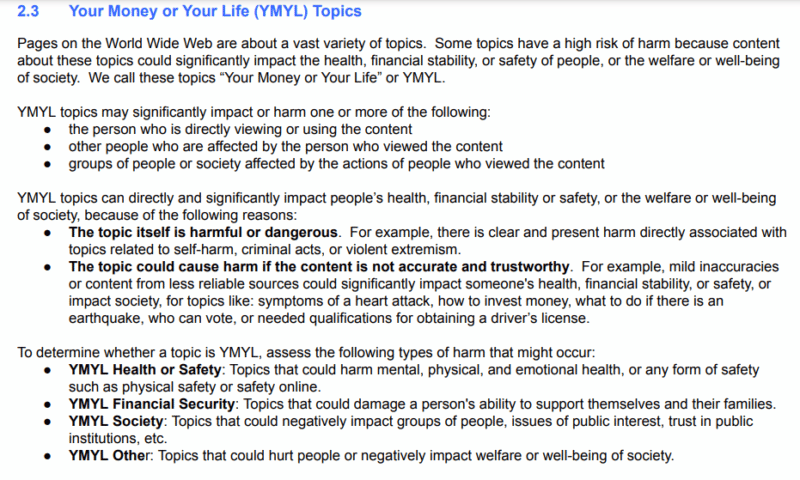
Google then defines YMYL topics as either being inherently dangerous (violent extremism), or harmful because presenting misinformation related to the topic can be harmful. For example, providing bad advice related to heart attacks, investments or earthquakes could cause harm to the user.
Instead of listing individual categories that may be considered YMYL, as in previous versions of the guidelines, Google now asks quality raters to think of YMYL in terms of four types of harm YMYL content can cause for individuals or society:
- Health or safety
- Financial security
- Society
- “Other”
In another new addition, Google claims that a “hypothetical harmful page” about a non-harmful topic, such as the “science behind rainbows,” is technically not considered YMYL. According to their updated definition, the content must have the potential to cause harm or otherwise impact peoples’ well-being.
In another big update, Google claims that many or most updates are not YMYL because they do not have the potential to cause harm.
Google also stated for the first time that YMYL assessment is done on a spectrum.
To clarify these new statements, Google provided a new table on page 12 of the guidelines, which specifically delineates the types of topics that Google considers YMYL or not, with clear examples.


Low Quality Pages – Section 6.0
Google revamped its definition of what it means to be a low-quality page.
In a previous version, Google claimed a page may be low quality, in part, because the creator of the main content may lack sufficient expertise for the purpose of the page. This statement was deleted.
Google now expands upon the role of E-A-T in determining whether a page is low-quality in three new paragraphs:
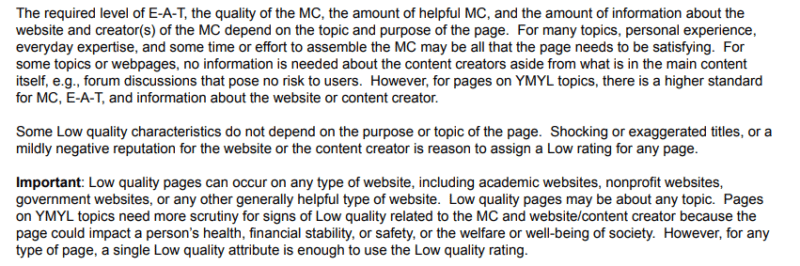
Google explains that the level of E-A-T required for the page depends entirely on the topic itself and the purpose of the page.
Topics that only require everyday expertise don’t require that the content creators provide information about themselves.
Google also suggests that a low-quality page can exist on an otherwise authoritative website, like an academic site or a government site. The topic itself of the page is where YMYL comes into play – if the content could potentially cause harm to the user, quality raters must evaluate that aspect when determining the quality of the page.
Lacking Expertise, Authoritativeness, or Trustworthiness (E-A-T) – Section 6.1
Google added a bullet point in its definition of what it looks like to lack E-A-T when determining whether a page is low-quality:
- “Informational [main content] on YMYL topics is mildly inaccurate or misleading”
In another new addition, Google once again repeated that the level of E-A-T a page requires depends on the purpose and the topic of the page. If the page discusses YMYL topics (and potentially presents harm to the user or others), E-A-T is critical.
Even if the website has a positive reputation, if there is a significant risk of harm, the page must be rated as low quality.

Lowest Quality Pages – Section 7.0
Google inserted a new section in the “lowest quality pages” section suggesting that even authoritative or expert sources can still present harmful content. This could include hacked content or user-uploaded videos.
Just because content exists on a site that otherwise demonstrates good quality, if the content itself is deceptive, harmful, untrustworthy or spam, this still requires a “lowest quality” rating.

Google’s new document about Search Quality Rater Guidelines
In addition to updating the Search Quality Rater Guidelines, Google also published a new resource describing how the Search Quality Rater Guidelines work. This resource includes sections about how search works, improving search and the quality rating process.
This document provides the most comprehensive overview to date of the role Google’s quality raters play in evaluating how well Google’s proposed changes are in line with Google’s own quality guidelines.
Google also provides information about who the raters are, where they are located and how the rating process works.
Why these changes matter
For those interested in understanding how Google defines the concepts of YMYL and E-A-T, Google’s updated Quality Rater Guidelines provide some new guidance about what they aim to achieve with their algorithm.
As opposed to thinking about YMYL in terms of business or content categories, Google asks raters to think about the extent to which content can cause harm to users.
Google also clarified that everyday expertise is sufficient for many types of content, but E-A-T is of the utmost importance when the content qualifies as YMYL (it has the potential to cause harm to individuals or society, or can affect one’s financial wellbeing, health or safety).
The post Google search quality rater guidelines update: What has changed appeared first on Search Engine Land.
from Search Engine Land https://ift.tt/yet0hNa
Comments
Post a Comment